
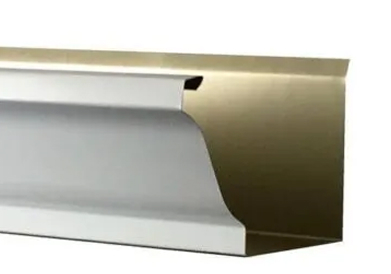
Why is it Called K-style?
Why Select K-style Gutter?
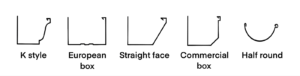
What other Gutter Options are There to Consider?
Can You Match Your Gutter Color to Your Home?


Other Matching Considerations
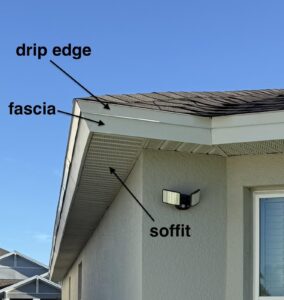
The drip edge (see image below) is a thin metal flashing installed along the edge of the roof that helps guide water into the gutters. For full-home gutter installations, in most instances once the gutters are installed the drip edge will no longer be visible, so it is not necessary to match the gutters to it. Likewise, the color of the soffit is rarely a deciding factor when choosing the color of the gutter.
Depending on the height of the fascia board, a small portion (usually a half inch or so of the fascia) may remain visible below the gutter in some areas. Because of this factor, it may be a good idea to take the color of the fascia into account when considering color choice.
Some homeowners have chosen to match their gutters to their roof color. In most instances, we do not find that this complements their home’s overall appearance. Similar to the way you would not consider your tires when choosing the color of your car, the roof is generally not considered an important factor in choosing a gutter color.
What is the Performance of K-style Gutters?
K-style gutter can be made from multiple materials, such as aluminum, copper, galvanized steel, and PVC. For residential homes, aluminum is the #1 choice due to its relatively low cost and durability.
Aluminum K-gutter often lasts 20 years or more with proper maintenance. The gutter coil is 100% aluminum, and contains no iron, so it does not rust. However, aluminum can still corrode over time, which is why keeping your gutters clean and well-maintained helps extend their lifespan and preserve their appearance.
What Size is Best for K-Gutters in Florida?
In Florida, gutter suppliers primarily offer 6” K-style gutter, with 7” coming in a distant second. This is because 6” gutters are generally the best suited for Florida’s heavy rains, combined with the lower roof pitches found on Southern homes.
A common misconception about gutter sizing is that the steeper the pitch, the larger the gutter required. In reality, the opposite is true.
Anyone who is from the North knows that homes in Northern states often have steeper roof pitches, typically between 6:12 and 8:12, to help snow slide off. When snow melts, it creates a steady runoff of icy water that can freeze on steps, sidewalks, and driveways, posing safety hazards. Because of these conditions, Northern states put gutters on homes as a standard fixture. The steeper roof pitch sends snowmelt and rainwater at a more direct angle into the gutters, which allows 5-inch gutters to be sufficient.
On the other hand, roofs in the Southern states, especially Florida, have a lower average pitch (3:12-6:12). With a gentler slope, rainwater can overshoot smaller gutters, making larger 6-inch gutters more effective. Florida also receives significantly more rainfall, averaging about 54 inches per year compared with Michigan’s 34 inches. This higher volume of rain can quickly overwhelm 5-inch gutters, which is why 6-inch K-style gutters are the standard in our area.
What about K-Gutter Thickness?
Thinking About Installing Gutters Yourself?
If you’re a DIY enthusiast, you can find K-style gutter materials at most local hardware stores. Keep in mind that they usually come in 10-foot sections that need to be joined together. This obviously can add a lot of extra work.
In order for gutters to function properly, every section has to be leveled and pitched correctly toward the downspouts so water does not pool. That can be tricky to achieve with sectional pieces, leading homeowners to seek out seamless gutter solutions. Fewer seams also means fewer leaks. After all, when seams are not sealed correctly, leaks can quickly become a real headache.
Another thing to consider is that gutters purchased at a hardware store can cost more than double what a professional company pays at a supply house. Once you factor in the cost of specialty tools like tin snips and crimpers, the potential savings of a DIY installation may not be worth the time and effort, especially for a whole-house project.